The Age of Extreme Power Laws

What do pitching to Venture Capital investors, swiping on dating apps and rising wealth inequality all have in common? The same mathematical invisible force is at work in all of them. Namely, Power Laws. Power Law Dynamics (‘Power laws’) are essentially the statistical principle that a tiny fraction captures disproportionate gains while the majority struggles. Now more than ever, unbeknownst to most of us, extreme power laws dominate our lives. Understanding them and why they have risen in extremity helps us to decipher many things about our world, including why it feels increasingly unequal, why more young adults are struggling to create lasting relationships, why K-Shaped economies have become our new normal and why the future of Africa is both exciting and alarming.
The math behind power laws reveal a sinister reality: when growth and preferential attachment go unchecked, extreme concentration isn’t an anomaly, it’s the natural state.
Defining Power Laws: When One Deal Returns the Entire Fund
For many years the venture capital industry has operated on a brutal mathematical premise that most outsiders find counterintuitive. If you raise a $50million fund and invest $5million into ten companies, conventional wisdom suggests you need most companies to succeed. The reality couldn’t be further from this: As a VC you need just one or two companies to return 10x ($50m) or more of the entire fund while the rest can fail completely. This isn’t hope over strategy. It’s math. Consider the case studies below:
- Founders Fund is arguably one of the best venture capital funds in the world with four consecutive funds that have reported DPI above 5x (over $5 returned for every $1 invested). Their crown jewel investment is SpaceX in which they started investing in 2008 and have made subsequent investments totaling $650million to $750million. Assuming SpaceX IPO’s at a conservative $800billion valuation, their estimated 10.4% stake would be worth $83billion. This represents a 4.9x return on their entire fund’s $17 billion Assets Under Management. Just from multiple bets on one company.
- Swiss based fund Index Ventures also offers a perfect illustration of power laws. Between 2012 and 2016, they invested $2.85million in Figma’s seed round and invested $5million in European fintech Revolut’s Series A round. When Figma went public in 2025 at $122 a share, their shares were worth $3.86billion, a staggering 1,355x return. As for Revolut (my favourite neo-bank), it gets even better, their current stake is estimated at $12.5billion, a phenomenal 2,500x return. These investments are statistical outliers that have redefined the entire fund's performance.
- Even outside the VC Elite, the power law reigns. Queensbridge Venture Partners is the VC firm of Nas aka God's Son aka the Cryptocurrency Scarface. They invested $100k–$500k into Coinbase’s 2013 Series B; When Coinbase went public via its IPO, their stake was worth $40–$200million. This represents a 400× return that most certainly exceeded the firm’s entire $10–$30million portfolio at the time. One bet, one fund returned.

Just as most startups in a portfolio fail while a few succeed spectacularly, most venture capital funds generate mediocre returns while a tiny elite capture disproportionate gains. The focus therefore shifts beyond simply picking winners, to participating in a game where extreme unequal outcomes are the only acceptable outcomes.
The Mathematics Behind Inevitability: Preferential Attachment
Preferential attachment is the mechanism that helps us understand why we increasingly observe extreme concentration emerging with such precision across many areas of our lives. It was mathematically formalized by physicist Albert-Laszlo Barabási.
The Barabási-Albert model is quite simple: the probability that a new node (customer, user, investor) connects to an existing node (company, city, person) is proportional to how many connections that node already has. Expressed mathematically:
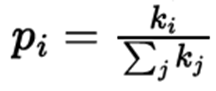
Where:
pi = the probability of connecting to node i.
Ki = the number of connections node i already has (its degree).
∑j.kj = the total number of connections across each individual node j that already exist.
The implications of the formula are profound. Assuming Node i has 10 individual connections and the sum of every node j's connection is 100, the probability of connecting to Node i will be 10%. If the network grows to 1,000 total connections, Node i will grow its connections to 70 via preferential attachment and the probability of connecting to Node i decreases to 7%. However if Node y now joins the network and has just 3 connections, the probability of connecting to node y is 0.3%. So even though the probability of connecting to Node i fell from 10% to 7%, Node y starts at 0.3% and will never catch up because Node i keeps compounding its head start. The gap between early and late entrants widens permanently (think about you vs. those lucky 2013 Bitcoin buyers). This is the power law in action.
Barabási proved something that is both intriguing and alarming: preferential attachment combined with continuous growth (new participants entering the system/ network) mathematically guarantees a power law distribution. Without both elements operating simultaneously, you cannot get this outcome. Growth alone produces a Geometric Distribution and preferential attachment alone eventually degrades into a Gaussian Bell Curve. Only together do they create the extreme inequality we observe.
Power Law Mechanisms: Natural Systems vs. Engineered Acceleration
Not all power laws are created the same way. Some arise from natural physical constraints, while others are deliberately engineered into digital systems. Understanding this distinction reveals why modern power laws have become more extreme.
Natural Power Laws: Zipf's Law and Physical Constraints
Power law distributions appear throughout nature wherever you have growth plus preferential attachment, constrained only by physical limitations.
Across countries and centuries, city populations conform to Zipf's Law with the same precision as a 41mm Rolex submariner. The population of the country nth-largest city equals P₁/n, where P₁ is the largest city's population. If New York has 8million people, the 2nd-ranked city should have approximately 4million, the 10th-ranked approximately 800,000. Why? Cities grow through migration and economic agglomeration. People move to where opportunities already exist, creating preferential attachment in human settlement patterns.
Engineered Power Laws: Digital Amplifiers
Modern digital platforms don't just observe power laws, they engineer and accelerate them through deliberate design choices.
Network effects: When you need a ride, you don't evaluate 20 ride-sharing apps. Depending on where you live, you use Uber or Bolt or Lyft because everyone else does, which means more drivers, faster pickup times and better prices (depending on where you live!). Each marginal user makes the dominant player disproportionately more valuable to the next user. This creates cascading advantages impossible in physical markets.
Declining marginal costs: Physical businesses face constraints as they scale that increase the cost of producing additional products. This has capped winner advantages. This isn't the case for pure software businesses that can actually experience lower costs even as they scale their products. Software distribution costs approach zero, removing the natural ceiling that previously limited how large winners could grow.
Information cascades: We use social proof as a heuristic under uncertainty. When choosing which startup to join, which VC to raise from, or which cloud provider to use, we observe what credible others chose. This creates cascading advantages: the company that wins the first few prestigious customers finds it exponentially easier to win the next ones. We don't evaluate all options independently, collapsing our decision trees.
Switching costs and lock-in: Once embedded in an ecosystem (Apple, AWS, Salesforce, Adobe), the friction of switching is often too high, creating advantages that compound over time. The leader's advantage is no longer due to a 10x better product but because using the alternatives becomes too costly whether in terms of time, context or $$.
The mechanisms mentioned above don't create any new mathematical principles. They rather remove friction that previously dampened preferential attachment, allowing power laws to reach their "natural" extremes.
Now that we understand Power Laws, we look at three major power law accelerants that have contributed to the extremes we witness around us.
Power Law Accelerant I: Globalization
The 1990s and 2000s gave us the comforting thesis that “the world is flat”: a level playing field where Bangalore and Boston, Shenzhen and Stuttgart, would compete on equal terms. The 2010s proved that the reality couldn't be further away from the truth: globalization plus digitalization didn’t flatten the world, they curved it into a landscape of extreme peaks and deep valleys, where a handful of cities, platforms, and funds capture a wildly disproportionate share of the gains.
Globalization didn't create power laws. Globalization removed the barriers that had fragmented and dampened them, allowing natural concentration dynamics to operate on a global scale.
Pre-globalization, a company's network effects were constrained by geography, language and distribution infrastructure. The leaders still won domestically, but the Total Addressable Market (TAM) had natural limits that capped the extremity of the outcomes. Post-globalization, that same company now faced hundreds of millions of users entering digitally connected markets simultaneously. When Whatsapp or Instagram acquired users, each new user in South Africa made the platform more valuable to the next user in Brazil, creating cross-border network effects that compound globally rather than plateauing at national borders.

Recall from Barabási that power laws require both preferential attachment and continuous growth. Globalization substantially increased both the numerator (connections to dominant players) and the growth element, i.e. the rate at which new nodes (customers, users, capital) enter existing networks. In most cases, when a company expands from 100million potential customers to 1billion, the time window during which a second-place competitor can catch up shrinks dramatically. The rate at which the leader accumulates new connections accelerates faster than the absolute number of "uncommitted" customers grows. The game ends before alternatives gain traction. Does anyone remember Dailymotion?
Globalization also intensified VC power laws by increasing global capital flows. Previously, top-tier US VCs competed primarily with other US VCs. Now, capital moves globally, but reputation and network effects don't distribute evenly. Sequoia can outcompete regional VCs and invest directly in Indian, Chinese, and European startups, leveraging their brand across borders. On the other hand, a regional fund in Prague cannot easily access Silicon Valley deal flow with the same credibility.
Globalization didn't introduce a new dynamic. It removed the friction that was dampening a natural mathematical tendency. Like removing a dam, the water always wanted to flow downhill according to gravity, but artificial barriers prevented it from reaching its equilibrium state.
Power Law Accelerant II: COVID-19's Digitize or Die Decree
If globalization gradually removed geographic friction over decades, the mandated COVID-19 lockdowns compressed digital adoption into 18 months, creating a forced experiment in preferential attachment never seen in history.
Was 2020 a bad year? It depends who you ask. The mandated lockdowns brought the emergence of K-Shaped outcomes where large capital firms and digital platforms recovered rapidly (Upwards) while small businesses and the hospitality, travel and physical retail sectors collapsed (Downwards). Essentially, the sectors that had existing network effects thrived while those that didn't either barely survived or shut down completely.

One industry that really captures this K-shaped outcome is movies. I recall vividly watching TENET in IMAX in an almost empty cinema (like the picture above), enjoying the incredible visuals and the masterpiece soundtrack. . Looking back, it’s quite poetic that I was watching a movie about time inversion while the cinema industry was beginning to invert itself. TENET's release symbolizes the beginning of the gradual decline of the cinema industry and the beginning of box office movies converging to extreme power laws, where only a few achieve commercial success while the majority flop. Between 2019 and 2020 cinema attendance in the US completely collapsed from 1.24billion tickets sold to 240million tickets. While this did improve post-COVID, ticket sales in 2025 were still 50% below pre-COVID peaks.
Contrast the decline of the cinema industry with that of Netflix. In 2020 alone, Netflix added 37million subscribers (beating their previous record of 28.6million in 2018), and broke the 200million total subscriber milestone. Since then they've grown subscribers by 98million to reach 302million by the end of 2024. This is preferential attachment at work: Disney Go and other streaming companies that were late to the party struggled and still struggle to compete with Netflix's edge in content acquisition, which has attracted more subscribers, which has helped to fund more content.
Another example of K-shaped outcomes is food delivery vs. restaurants: Uber Eats revenue exploded from approximately $1.9billion in 2019 to $4.8 billion in 2020 (153% growth), then $8.3 billion in 2021 (73% growth). DoorDash gross order volume jumped 70% in 2021 after massive 2020 gains, reaching $42billion. The company went public in December 2020 at the pandemic's peak, capitalizing on structural advantages.
While delivery platforms experienced record demand and revenue growth, independent restaurants faced severe losses, with many closing permanently. Ignore the Salt Bae restaurants, the Nobu's or the Carbone's, they are exceptions to the norm. Anomalies. The platforms captured network effects (more restaurants = more users = more restaurants) while the physical establishments absorbed all the downside risks.
The final sector that highlights K-shaped outcomes is retail. As e-commerce giants like Amazon and omnichannel players like Walmart and Target thrived, thousands of independent retailers permanently closed. Those with existing scale and digital infrastructure captured gains; pure physical players faced a different fate.
The COVID lockdowns essentially eliminated people's choice to remain in physical channels, resulting in a forced migration to digital networks. This inorganic adoption has resulted in near-permanent behavior changes. Netflix has maintained the lowest churn rates in its key markets. Doordash has grown order volumes 10x since 2019. Zoom, Teams and Meets remain key parts of our lives. Changes that would've taken five years or more to form instantly became the New Normal. The lockdowns didn't just accelerate trends, they removed the possibility for alternatives to emerge.
Power Law Accelerant III: AI's Exponential Multiplier
This section isn’t an AI Doom thesis à la Citrini. Rather it's an overview of the exponential multiplier effect AI is already having in accelerating power law concentration.
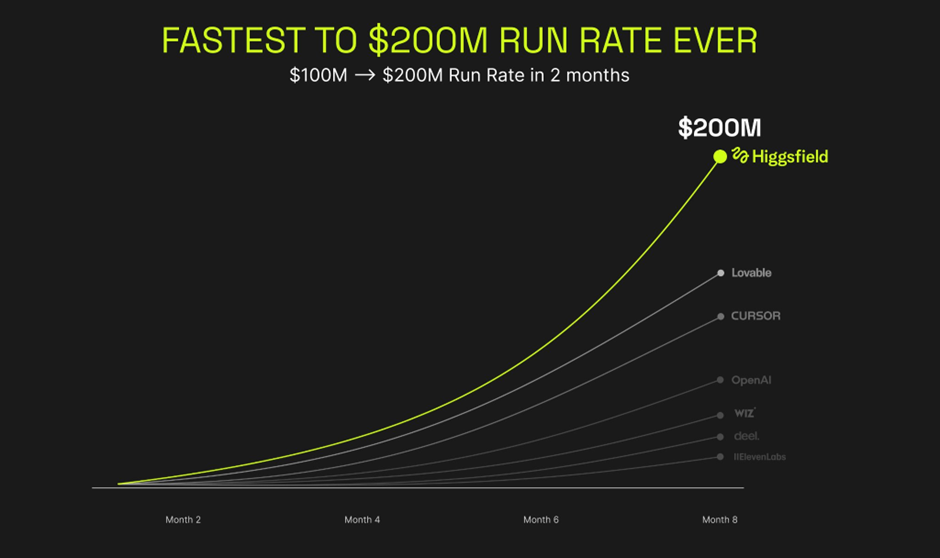
Whether it's the chart above or Anthropic's insane run rate revenue growth chart, the picture is clear: Companies producing AI based products and services are growing exponentially at rates never seen in history. Andreseen Horrowitz's AI Apps team explained on the A16Z Show that this is because AI is not a net new platform, rather it's built on top of PCs, the internet, the cloud and mobile infrastructure. The result is adoption curves that are steeper than any prior wave.
The exponential growth curves we observe says a lot about what AI does in displacing different categories of friction. AI eliminates the friction required to scale by exhibiting near zero marginal cost of replication. Physical businesses typically face scaling constraints while OpenAI's ChatGPT gained 100million users in two months, faster than any product in history.
Additionally, AI powered systems can process global data almost instantaneously, collapsing any kind of information friction. Take the example of panicselling.xyz, which aggregates and tracks the changes in prices of real estate property available for sale or for lease in the UAE following the start of the conflict in the Middle East.
There are many reasons why the rollout of AI amplifies power laws. The first being its recursive self-improvement capabilities and data network effects. Unlike previous technologies, AI systems improve as a function of their own dominance. By getting better the more they are used and trained, the more valuable they become. This recursive loop operates at machine speed, compounding preferential attachment daily rather than annually. The proof is in the pudding: earlier this year engineers at the leading AI Labs shocked the world when they shared that they no longer write code themselves.
The second reason AI amplifies power law is that AI models have evolved towards Agentic AI. These are systems that can autonomously plan, reason, and execute multi-step tasks, including performing complex cognitive work such as legal analysis, financial modelling, medical diagnosis and more. The result is that less labor is needed to generate the same economic output. Anthropic vs. ServiceNow is a great example, both companies sell software products and generate $14-15Billion in Annual Revenue, however Anthropic has +2,500 employees while ServiceNow has 29,000 employees. Dario Amodei, the CEO of Anthropic has actually repeatedly warned about the potential impacts of AI on the labor market especially for entry-level roles. His warnings mirror those of the prophets in the Old Testament, warning the Israelites about the arrival of the Babylonians. Similarly, those warnings seem to fall on deaf ears. It is thus very likely that increased adoption of Agentic AI gradually creates K-shaped outcomes in employment and unemployment.
The final reason AI amplifies power law is that training frontier AI models requires billions in capital and specialized infrastructure. Only incumbents (Microsoft, Google, Meta, Amazon) or exceptionally well-funded startups (OpenAI, Anthropic, xAI) can compete. In early 2026, the spending arms race officially reached new levels as the four Big Tech incumbents announced they'd be spending $660 billion in capex directed towards AI data centers, custom silicon, and energy infrastructure. To put that into perspective, that's more than all venture capital funding deployed globally in 2025. That's power laws on steroids. The kind that even Arnold Schwarzenegger wouldn't dare to touch. Once this infrastructure is built, who will be able to compete?
There are many visible impacts resulting from the power law accelerants I mentioned but I have chosen to focus solely on three.
The Impacts I: Winners Take Everything

The biggest outcome of the emergence of extreme power laws is that the leading companies increasingly capture a larger portion of the markets they operate in. Globalization + sound strategies enabled startups to blitzscale and compete for global markets from inception, expanding the total addressable market by orders of magnitude, capturing 1,000x (like Revolut and Figma) returns instead of 100x. However, the number of category winners didn't increase proportionally.
Stripe, the fintech giant that partners with businesses responsible for 1.6% of global GDP, recently shared an alarming statistic in their 2025 Annual Report highlighting that "winners take everything": 10% (50 companies) of the 500 companies in the S&P500 Index accounted for 60% of all profits in the Index. This represents extreme concentration.
Power law concentration isn’t just in companies; it governs VC and private equity funds themselves too. The funds that produce great returns are able to raise a disproportionate amount of capital to continue investing often at better terms. Other firms raise less, struggle to raise capital or experience withdrawals from their Limited Partners (LPs). Take Andreessen Horowitz, their $15 billion fundraise in 2025 represented 18% of all US VC funding that year. A single firm received nearly one‑fifth of the entire domestic market, or 3.5% of global VC funding.
The result of all this concentration is rising wealth inequality. The kind that French economist Thomas Piketty has been sounding the alarm on. The K-shaped economy that begun during COVID-19 has become structural, not cyclical. In Europe, the top 10% of eurozone households held 57.4% of total net worth, while the bottom 50% held just 5%. It gets even worse across the Atlantic. In the USA, the top 10% of households account for nearly 50% of all consumer spending.
These outcomes aren't separate. The Matthew Effect is a principle that was coined by sociologist Robert K. Merton inspired by this passage of the Gospel of Matthew, verse 25:29 "For to every one who has will more be given, and he will have abundance; but from him who has not, even what he has will be taken away." The essence of the Matthew Effect is that initial advantages (or disadvantages) compound over time into structural dominance, which is what we are observing.
Based on our understanding of power laws and the lack of coherent actions taken to slow down these impacts, we can confidently assume that these outcomes will only compound until a point of no return is reached. After all, in the image above, Le Chiffre doesn't seem too concerned about his winnings.
The Impacts II: The Relationship Gulag
In Call of Duty: Warzone, the Gulag is the ultimate test of elimination. You enter with one chance, face a single opponent, and only one of you comes out. Lose, and you're done. Until the next campaign. The modern dating market has quietly adopted the same architecture. Power law dynamics now go beyond markets, companies and funds. They're now present in the most intimate part of human connection, creating K-shaped outcomes in loneliness and family formation.
Dating apps removed switching costs (no geographic constraints, infinite supply of alternatives) and massively increased the "growth" parameter (billions of users globally). This created textbook preferential attachment: the best profiles get more likes, which makes their profiles more visible algorithmically, which attracts more likes. The algorithm amplifies this: swipes and messages create feedback loops that further concentrate attention on winners. The data supports this: On Tinder, the top 20% of men receive approximately 80% of women's likes, while the bottom 80% of men compete for the remaining 20%. For women, the distribution is less extreme but still skewed, the top profiles receive disproportionate attention.
Social media created secondary power laws that completely distort relationship expectations. Viral "dating advice" (red pill, feminism, toxic masculinity, tradwife content) from complete strangers follow power laws. Extreme content gets disproportionate engagement, creating echo chambers that amplify unrealistic standards. Social media turns relationships into public performances where "success" is measured by likes and validation from strangers, not mutual satisfaction. This creates additional preferential attachment where couples with high social capital get more attention, shifting expectations for everyone else.
The profound impacts of this are mostly visible in OECD countries (for now) and most of you reading this are probably already aware of the outcomes: declining marriage rates for young adults in their 20s-30s, declining fertility rates well below the replacement threshold and a massive jump in people identifying as single. In 2025, France had more deaths than births for the first time since World War Two. A "new normal" has slowly taken shape. What was previously normal is now trending towards the exception.
Governments have been proactive in trying to address this matter. For example, Hungary introduced several measures to encourage and increase childbirth within the country, including offering tax exemptions. However our understanding of power laws shows that once gaps have widened by a margin too large, they are difficult to close. It is therefore reasonable to assume that the demographic challenges in OECD countries will continue to persist. What this implies is more people waiting in the Gulag or worse, renouncing human connections altogether and replacing them with AI companions.
The Impacts III: Africa & A Tale of Two Cities
Having repeatedly lived between Africa and Europe, I believe this passage from Charles Dicken’s classic novel perfectly captures the impacts of extreme power laws on the African Continent, assuming the status quo remains (ceterus paribus as we learned in economics).

Africa represents the world's largest uncontrolled power law experiment: unprecedented population growth + urbanization + digital penetration + weak redistribution capacity. If K-shaped economies are becoming structural in OECD economies, African countries are already K-shaped in nature: large informal sectors with weak earning capacity and medium sized formal sectors that are gradually expanding. Wealth inequality is therefore already at power law extremes. Oxfam highlighted this with a staggering statistic: The four richest people in Africa have more wealth than half of the regions 750million people combined.
Demographics is destiny. The population boom taking place on the continent is expected to grow existing the population from 1.4billion currently to 2.5billion in 2050, with 80% of growth occurring in urban areas. Major metropolitan cities like Lagos, Kinshasa, Addis Ababa and Dar Es Salaam will follow Zipf's law as they scale in the number of inhabitants, concentrating capital, talent and infrastructure.
The population growth will create massive demand for digital products and services, and the companies dominating those key markets will benefit from power laws. This observation is cemented by the exponential growth in tech investments on the continent: funding grew 10.6x from $367million in 2016 to $3.9billion in 2025. This long-term trend will only continue. Companies building physical infrastructure (housing, buildings, clinics etc.) and physical products (furniture, food, clothing) will also benefit from the growth in this aggregate demand. AI will be an accelerant for the next generation of African founders, as it will lower the cost of figuring out what to build and how to build it. Some sectors will thus see a new set of local champions emerge, while others where the existing competitive advantages are already too large, the Matthew Effect will hold and expand the gaps. Good luck to those competing with Dangote in fertiliser production or with Transsion Holdings for Africa's smartphone market.
As this population boom takes hold, the gap between countries that are gradually growing and improving and those that are regressing will only amplify. As such, the best cities Abidjan, Cape Town, Accra, Nairobi, Casablanca (to name a few) will increasingly receive stronger interest and demand from both Africans living on the continent and Africans in the diaspora, cementing themselves as hubs on the continent (if it isn't already the case). This heightened demand will drive living prices in these cities higher, increasing the burden for residents that don't have the same mobility options or earning power (it's already happening in Cape Town), further widening the gaps.

The gap between African countries is already visible if you look at economic weight and investment flows. The Matthew Effect is already at work. Four countries: South Africa, Nigeria, Kenya and Egypt absorbed 84% of all VC funding in 2025. It gets worse if you include Morocco.
As Oxfam pointed out, African countries have weak wealth redistribution capacity. This was apparent during the COVID19 outbreak, which revealed the weaknesses that governments have in managing power law dynamics. Contrast this with China and Switzerland, two countries that have demonstrated that power laws can be deliberately moderated through sustained policy intervention despite their difference in size and governance approach. It is for this reason that despite the massive opportunities the continent will create over the next decades, its future remains both exciting and alarming.
Role of Governments
China’s one child policy (1980-2015) wasn't framed as a power law dampener, but it functionally operated as one. By limiting population growth, China reduced the rate at which “new nodes entered the system”, preventing Zipf’s law from taking its true form by slowing the speed at which megacities like Beijing and Shanghai could compound their advantages over second-tier cities. China has also been operating a unique & controversial internal mobility model known as the Hukou System, which artificially restricts families from migrating from the cities where they’ve been registered. This has prevented the natural preferential attachment that normally drives everyone to top-tier cities.
China has equally made significant infrastructure investments in second-tier cities such as Chengdu, Hangzhou and Wuhan. Massive high speed rail networks have also been developed to ease mobility between cities. As a result, second-tier cities have experienced rapid, urban industrial growth.
The overall outcome is the following: China has roughly 15 metro areas with populations above 10million, compared with about 6 in India and just 2 in the USA. They've artificially broadened the distribution, creating multiple regional hubs rather than allowing natural winner-take-all dynamics.

Switzerland, the land of picturesque landscapes and high precision watches, with its 9million people has deliberately prevented Zurich from dominating Geneva, Basel and Bern by orders of magnitude. How? Through engineered polycentric policies and structures.
Political power in Switzerland is constitutionally distributed across the country's 26 cantons, preventing a single dominant city from capturing all government functions, talent, and capital. This is artificial preferential de-attachment: structural barriers that prevent natural concentration. Similar to China, Switzerland boasts world-class rail infrastructure that easily connects secondary cities (Lucerne, Zug, Lausanne) and facilitates inter-city mobility. This reduces the preferential attachment advantage that proximity to Zurich or Geneva would naturally create. By making all cities equally accessible, the network topology has been flattened.
Both countries prove the role of policy in shifting power law outcomes, but only through structural policies requiring either deep civic trust (Switzerland) or authoritarian capacity (China). Unfortunately, not every country has the same capacity or levels of democracy and trust.
Final words
If you’ve made it this far, you understand that we are living in the Age of Extreme Power Laws. Power Laws are real. They are forces that are both natural and by design. They are at work in the background in many parts of our lives, invisible to the naked eye. They were previously operating within constrained boundaries but they’ve now been unleashed thanks to a combination of continuous growth, preferential attachment and minimal friction. K-shaped outcomes are either forming or strengthening in many parts of life.
Whether we like it or not, power laws impact our lives and they cannot be ignored. These observations require a moment of reflection: Are power laws currently working in your favor or against you? If they are working against you, what will you do differently? Recall the Barabási-Albert formula, it's all about identifying the right node to be a part of. This article itself is in many ways an experiment in power laws: it will either capture disproportionate attention or fade away into the abyss.