The Pac-Man Maze Thesis
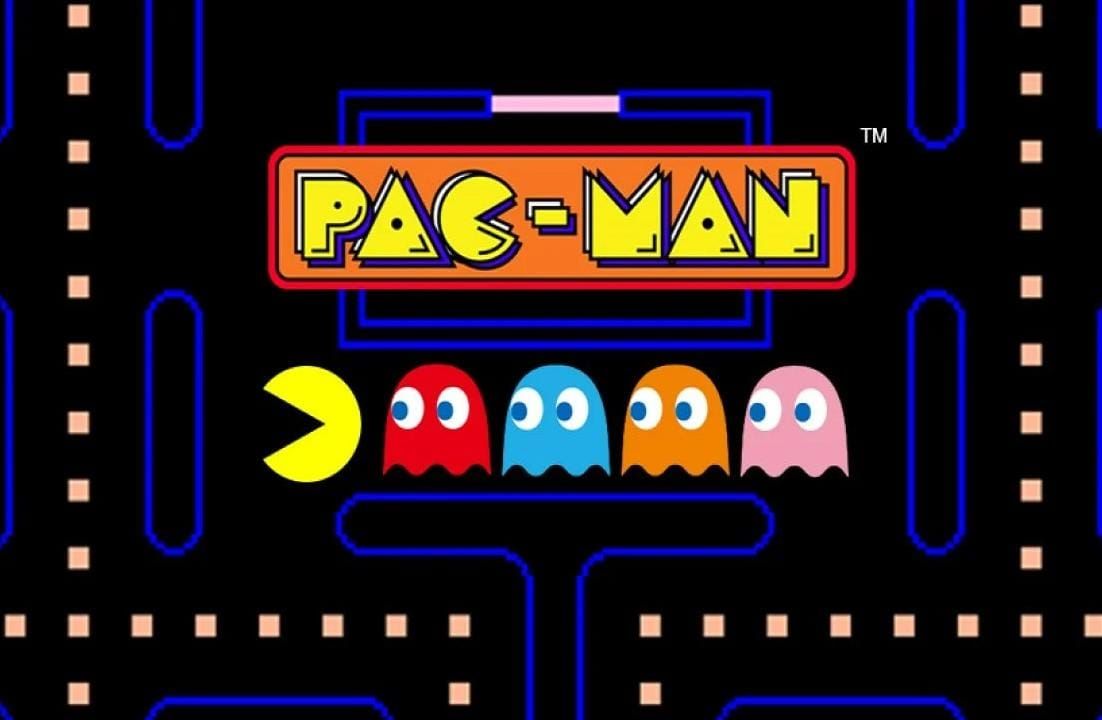
When it comes to video games that have impacted pop culture and the world, it doesn't get more iconic than Pac-Man: that special yellow character gobbling his way through a maze while being hunted down by four ghosts. Created in 1979 in Japan and released to arcades in May 1980, Pac-Man today is one of the most successful arcade games of all time, having generated an estimated $14B in sales. Pac-Man also provides a great framework to visualize, describe and assess the challenges that startups, SMEs, and emerging challengers alike are navigating today. Welcome to the Pac-Man Maze Thesis.
Pac-Man, originally called PuckMan, was designed in 1979 by Toru Iwatani, a game designer at the legendary studio Namco (behind other iconic games Tekken, Ridge Racer and Soulcalibur). The ambition behind Pac-Man was simple, to build a non-violent game that anyone could play at a time when arcades were almost exclusively designed for young men firing at things. The spark for the character’s shape came at a rather mundane moment: Iwatani ordered a salami pizza, took a slice, and looked at what remained. That gap in the circle became a mouth, and a cultural icon was born. The name followed from Japanese slang: paku paku taberu, meaning to gobble something up with repeated snapping of the mouth. Inside the maze, Iwatani populated the world with four ghosts: Blinky, Pinky, Inky, and Clyde. Each Ghost was programmed with a distinct individual behaviour: one chases directly, one ambushes from the front, one flanks unpredictably, and one retreats when it gets too close. None of them were designed to coordinate. Yet together, their individual routines produce pressure on Pac-Man that feels eerily like being hunted from every direction of the maze simultaneously.
That pressure is precisely the dynamic that small businesses and startups face today. It maps precisely to the Pac-Man Maze Thesis. We previously highlighted that we live in an Age of Extreme Power Laws, where the removal of friction, the compounding force of preferential attachment, and the arrival of Generative AI have widened and continue to widen the gaps between winners and everyone else to historic extremes. The result is a maze that is structurally designed to concentrate survival among the few.
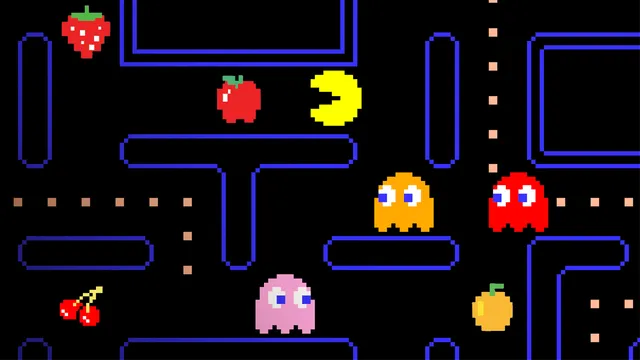
In the Pac-Man Maze Thesis, Pac-Man is an emerging business or startup (‘Challenger’): always hungry, always moving, perpetually exposed in a world built around threats. The dots are revenue and customers. The simple, small, incremental wins required to advance to the next levels of the maze. The maze is the world itself: a structured system with no exit, where the only option is to keep moving. The ghosts, as we will explore throughout this thesis, are Big Tech, the AI labs, and other challenger businesses. The ghosts in the Pac-Man Maze Thesis prevent Pac-Man from reaching the next levels and becoming a thriving, scalable business. The stakes reflect this reality: approx. 90% of startups fail, and for small businesses the odds are only marginally better, with around 20% closing within their first year and nearly half gone within five. The maze becomes harder to escape because the ghosts keep adding walls.
Luckily, there is one element of the game that shifts everything briefly, brilliantly, and always temporarily. The Power Pellet. When Pac-Man consumes one, the dynamic flips on its head: the hunter becomes the hunted, and the ghosts become vulnerable, although for a short-moment. It is the game's most psychologically charged feature, representing those rare moments when a challenger finds an asymmetric advantage powerful enough to accumulate enough dots to advance to the next level. We will return to the Power Pellet. But first, we must understand the ghosts.
The Ghosts with “Why Shouldn’t I” Syndrome
In the Pac-Man Maze Thesis, the ghosts do not need to be faster than you. They only need to control the corridors. Big Tech has mastered this geometry. They are flush with capital that they can either easily raise (recall that Google’s $20B bond offering was 5x oversubscribed) or spend: as announced that they collectively will be spending over $800B in capex for 2026 alone. The Mag 7 companies, including Amazon, Google, Meta, Apple, and NVIDIA do not merely compete. They patrol. And when a promising dot-eater appears in their maze, the calculation is not can we win? It is simpler, and far more dangerous: Why Shouldn't I?
Amazon's White-Label Ambush
Amazon built the world's most efficient marketplace and then turned it into a hunting ground. Amazon Basics is the logical conclusion of having perfect information: years of aggregated seller data informed Amazon exactly which product categories were profitable, which price points converted, and which third-party brands were too small to fight back. The result is a platform that simultaneously hosts your business and quietly competes against it. Sellers who built their livelihoods on Amazon's shelves discovered, too late, that the landlord had opened a competing shop on the ground floor. Why Shouldn't I? The data was right there.
The Shovel Supplier That Went Mining
NVIDIA supplies the shovels to every miner in the AI gold rush and one morning shocked the world by announcing it would start mining itself. The launch of Nemotron, NVIDIA's own large language model, sent a pointed message to the OpenAIs’ and Anthropics’ of the world: the company powering your intelligence is now building its own. It is a breathtaking position. Customers cannot easily abandon NVIDIA's GPUs (yet) as there is clearly no comparable alternative at scale. So, the AI labs that depend on NVIDIA's silicon must now watch their infrastructure vendor inch into their product lane. Sometimes the ghost doesn’t need to outrun you. It just needs to wait at the intersection.
The Design Layer Land Grab
Figma survived Adobe's $20B acquisition attempt only to find new ghosts in the corridor. Google's Stitch and Anthropic's Claude Artifacts recently arrived in the design and prototyping space with a straightforward value proposition: what if the tools that designers use were natively wired to AI? For Figma, which spent years building the definitive collaborative design platform, the threat is a coordinated movement from companies with deeper pockets, captive distribution, and clearly nothing to lose. In the maze, sometimes two ghosts approach you from opposite ends.
Meta: From Infinite Scrolling to the Coronation
Meta is the maze's most elegant ghost because it does not need to acquire what it can simply replicate at scale with a billion users. Snapchat invented Stories; Meta cloned it and buried Snapchat's growth curve in a single product cycle. TikTok cracked short-form content; Instagram Reels is now a standalone $50B business. Then came Threads, Meta's answer to Twitter/X, which crossed 300 million users with over 100 million logging in daily. Threads achieved the kind of growth that most social platforms spend a decade chasing in just over a year by simply plugging into Instagram's existing social graph. Meta's genius isn’t innovation but rather metabolization. It watches which format is winning attention, absorbs it into the Instagram and Facebook surface area, and floods it with its unrivalled ad-targeting engine. Usage remains partially unaffected too.
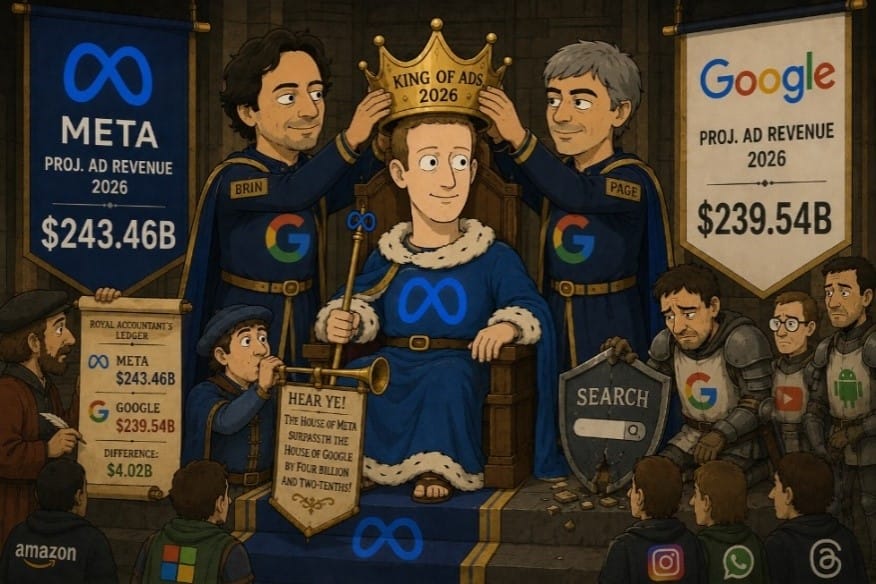
The result of this strategy is a CORONATION that few saw coming: Meta's advertising business is projected to officially dethrone Google's this year, making it the single largest destination for ad dollars on the planet. But the most unsettling chapter may still be ahead. Meta rolled out AI influencer Chatbots. These were synthetic personas powered by its own models, trained on the most comprehensive dataset of human attention ever assembled. Meta knows precisely what stops a thumb mid-scroll and what keeps eyes locked to a screen. Although they were shut down after public backlash, one ponders: When the most powerful ad machine in history also controls the influencers running on it, the question for Meta is no longer whether they will use AI to advertise. It is simply: Why Shouldn't I?
Apple and the Strait of Apps
Without exception, every application on a billion iPhones must pass through a single checkpoint: the App Store. Apple's 30% toll and its opaque review guidelines make it the world's most powerful digital customs authority. Occasionally, its most insidious. Cal AI is a breakout $50M calorie-tracking app that is recently estimated to have been acquired for $100M. They learned the hard way not to bypass the strait of Apps. One day after introducing a payment gateway that took customers off the Apple ecosystem, bypassing Apple’s guidelines, they were removed from the App Store, the effect was immediate and total. There was no appeal to a higher court. (Cal AI is back on the App Store now!)
Epic Games also learned this the hard way. Their years-long legal battle with Apple over App Store fees ended with Fortnite remaining off the App Store for five years! A bruising lesson in what happens when you challenge the customs authority on its own terms. Apple's decision to block Cal AI mirrors a tanker being denied passage at the Strait of Hormuz, the goods are real, the demand is there, but without passage, nothing moves. Apple's power comes from the fact that it doesn’t have to compete with every app. Control the strait, and you control the sea. In the Pac-Man Maze, most ghosts chase you through the corridors. Apple is the ghost that waits at the exit and quietly walls it up. When an app-maker doesn't respect the rules, removing them from the App Store is merely a question of Why Shouldn't I?
Google's Perfectly Hedged Bets
Perhaps no maneuver in the modern tech is more coldly rational than Google's relationship with Anthropic. Google has invested billions in the “AI Safety First” company and supplies it with TPU compute, the essential lifeblood of any model training run. It is also building Gemini, a direct competitor to Claude, with the full weight of Google DeepMind behind it. In any other industry, this would be called a conflict of interest. In Big Tech, it’s called portfolio management. If Anthropic wins the AI race, Google participates in the upside. If Gemini wins, Google wins outright. The ghost, in this instance, has found a way to be on both sides of the wall simultaneously.
Keeping Pac-Man in the Maze
The "Why Shouldn't I?" Syndrome is a consequence of extreme power laws. When power laws converge and compound to produce companies of this scale, the competitive assessment collapses into a single brutal question. Every emerging challenger exists on a spectrum of outcomes entirely within Big Tech's control: they can be copied, acquired, blocked, or simply invested in. The ghosts don’t need to choose a strategy in advance. They can simply wait until your corridor becomes interesting and then decide whether you are more valuable as a target, a subsidiary, or a cautionary tale. Reaching the next level in the Pac-Man Maze is difficult because the Ghost chooses how to catch you.
The Lean Ghosts Growing Exponentially
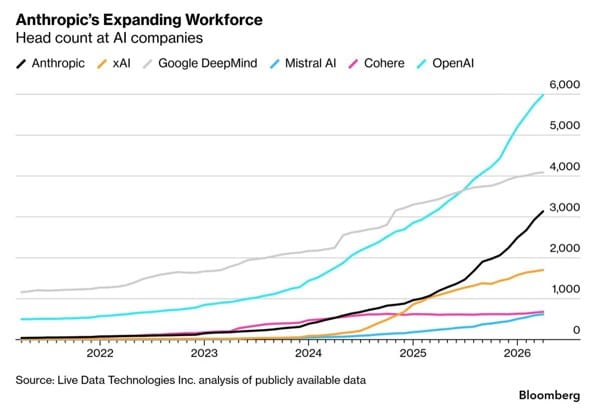
The ghosts of Big Tech are not alone in the maze. They have apprentices. The 'Why Shouldn't I?' Syndrome is not exclusive to the trillion-dollar incumbents. It’s a power law disease that the leading AI labs have caught in real time. However, this set of Ghosts are unique, they’re growing exponentially but with much smaller teams than any previous generation of companies at comparable scale and influence.
OpenAI: The Founding Ghost
OpenAI is the Ghost that opened Pandora's Box that is still gunning for the top spot. It is the undisputed leader in consumer AI, with roughly 900 million weekly active ChatGPT users, while continuing to scale rapidly in both valuation and revenue; by March 2026, it was valued at around $850B with an estimated $25B in ARR, alongside growing enterprise adoption. But its path has not been perfectly linear. At times, it spread its attention too widely, and Sora is a good example of how its ambitions can outrun its focus. More recently, though, OpenAI appears to have refocused on the areas where it is already bearing fruit: coding and image generation. Codex has reached 5 million weekly users, and Image 2.0 is now competing strongly with Google’s Nano Banana. Sora still matters though, not really as a product, but more as a signal of how far OpenAI intends to push its ambitions.
Anthropic: The Safety-First Enterprise Reaper
Anthropic is the clearest example of a lean ghost growing exponentially. In just over five years, it became the fastest company in history to surpass a $950B valuation, while scaling from fewer than 1,000 to more than 300,000 enterprise customers in roughly two years. It also reached $30B in ARR in March 2026 with only about 2,500 to 3,000 employees, an extraordinary level of efficiency compared to traditional software companies. Brad Gerstner of Altimeter has echoed this as well, he noted that when Google crossed the same threshold they were 120,000 people. Beyond the scale and speed, there is the strategic concentration. Anthropic has focused intensely on coding and enterprise workflows, and the explosive growth of Claude Code shows how far that concentration can go. At the same time, the launch of 11 plugins alongside Claude demonstrates ambitions that extend well beyond the enterprise core, reaching into legal, finance, product management, and other workflows across sectors. Whether you believe Saas is dead or not, Anthropic is the Grim Reaper that caused the Saaspocalypse and seems to just be getting started. Hint: Mythos.
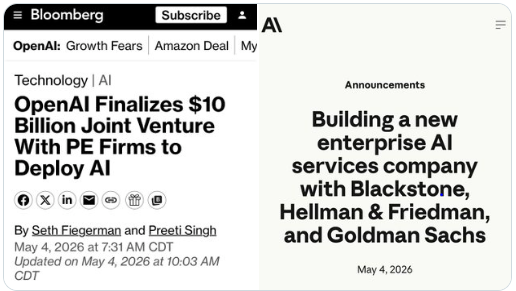
The main battleground for the AI labs used to be about who had the better performing model. This has now shifted to who has the most adoption, specifically within companies.
The most underappreciated move of the current AI cycle is the symbiotic handshake between the AI labs the Private Equity Incumbents. The game theory on this is clean. PE firms are sitting on a record backlog of unsold portfolio companies, margins under pressure, and LPs demanding returns in a sluggish exit environment. AI labs need more paying enterprise customers to justify their valuations and maintain their exponential growth curves. The solution is straightforward: PE firms deploy AI across their portfolio companies to improve efficiencies; the labs get a captive, paying customer base that incumbent SaaS vendors cannot easily poach. OpenAI’s Deployment Company gets access to +2,000 portfolio companies managed by over 15 leading firms. This goes beyond licenses too, OpenAI engineers directly embed themselves within the client organisations. This strategy ultimately ensures the Lean Ghosts Growing Exponentially Stay In The Game, while further extending their reach across sectors (logistics, healthcare, finance) and creating high retention via switching costs. For emerging challengers, this is what makes the next level so difficult to reach. Those portfolio companies are potential future clients, and if the Symbiotic Alliance holds, the gates aren’t just higher they may be closing permanently.
"I'm Looking at the Ghost in the Mirror" (RIP MJ)
Not every ghost in the maze was born one. This is the ghost that’s the hardest to argue against because it’s not Big Tech or multi-billion-dollar VC backed AI labs, it’s simply another Pac-Man, trying to survive and thrive, whose very existence makes yours more precarious. More apps than ever are flooding the App Store, a trend that shows no sign of reversing thanks to vibecoding and the lower barriers to creating apps with AI. As the number of active apps continues to rise into the millions, that creates serious implications.
The Barabási-Albert model, explored in depth in Age of Extreme Power Laws, makes the mechanics of this brutally clear. As more nodes enter a network, the probability of any single node capturing new connections decreases. Applied to the app/online business economy, this means that every new app entering the market more than just compete with you directly. Beyond competition, they dilute the attention pool, fragment discovery algorithms, and mathematically reduce your probability of breaking out. Netflix illustrates this logic in content: the platform produces hundreds of original titles annually, yet only a handful capture the cultural conversation while the rest fade into the options menu. Essentially more content, thinner odds for each.
The same logic applies beyond apps to any market where digital entry barriers have lowered: e-commerce, newsletters, creator content, SaaS tools. The removal of friction that power laws depend on works in both directions: it is easier than ever to build something, which means it is harder than ever to be found. Every new Shopify store, every new newsletter (including this one), every new B2B tool represents a new ghost in someone else's corridor. None of them intend to haunt or pressure you. They are simply trying to survive the same maze. And in a world governed by preferential attachment, their presence alone is enough to thin your odds.
Feltsense is software company creating AI Agents that act as founders, capable of ideating, creating products, shipping and capturing market share with limited supervision. The company faced immediate backlash earlier in the year when they shared that their “Agentic Founders” had replicated every startup in Y Combinator’s 2026 Winter batch. People called it distasteful, but the real question is: Should they be mad at the founder? After all, he’s also a Pac-Man in the maze. A challenger trying to avoid the Ghosts and make it to the next level. That’s the dilemma of the Ghost In The Mirror.
The Specialised Ghosts Taking Shape
There is one final category of ghosts worth paying attention to: specialised AI application labs. These are highly focused teams with billions in backing, built not to compete broadly across the entire application layer, but to push deeply into industries that many incumbents and challengers alike may still assume are partially insulated from AI disruption. So far, they include Project Prometheus and Isomorphic Labs. Their emergence signals that pressure will gradually move beyond software development toward manufacturing, biotech, and pharma, where the consequences of applied intelligence could be bigger than is currently priced in.
Project Prometheus is particularly worth watching. Backed by BlackRock and JPMorgan Chase and co-led by Jeff Bezos, it points to a future where AI plays a more central role in physical production, manufacturing systems, and real-world industrial processes. Isomorphic Labs plays the same role for biotech and drug discovery. With deep ties to Google and a mission focused on applying advanced AI to biology and pharmaceuticals, it shows how the logic of the frontier labs is now being chanelled into highly specialised scientific applications.
The next generation of ghosts won’t just be chasing software companies; they’ll be chasing any industry whose bottlenecks can be translated into intelligence.
Power Pellets
We’ve covered the Ghosts but now let’s focus on what helps a company reach the next levels of the Maze despite the presence of the Ghosts. The Power Pellets. Depending on how well you can navigate the maze, the number of Power Pellets required to advance to the next level will always vary. However, in most cases it's clear that more than one will be needed to make it out.
The Kingdom of Heaven, Moats and the Power of Relationships (Warning: Spoilers)
The first Power Pellet is the oldest strategic asset in human history: relationships. One of the clearest illustrations of this is shown in Ridley Scott’s Kingdom of Heaven (the Director’s Cut!). In this film, Balian of Ibelin defends Jerusalem from Saladdin using three distinct layers of protection: the outer wall, the inner citadel and the people inside.
1. The outer wall. This is the visible deterrent: the fortifications, the barricades, the barbican and loopholes that deter any attacker protect the city.
2. The inner citadel. This is the core asset that remains standing and valuable even if the outer wall collapses.
3. The people inside. These are the relationships and trust so deep that people willingly fight without being paid, advocate without being asked, and stay when every rational signal says to leave.
In Kingdom of Heaven, Jerusalem’s defense was no match for Saladin’s army. Yet thanks to the trust, humanity, and the reputation that Balian cultivated, he was able to negotiate an exit that preserved lives: Saladin granted safe passage to the people of Jerusalem. The city fell but the people survived. The moat was never the design of city’s defense. It turns out, the moat was ultimately the people.

The implication for online businesses in the maze is crystal clear: invest just as much, if not more, in relationships than in product features. Features can be replicated in a quick product cycle but customers that trust you can become distribution; and partners who believe in you can become moats. Notion is the clearest case studies of community as a growth engine. They invested early in community, hired a Head of Community almost immediately, learned from an informal Slack group of power users, supported ambassador-led meetups, and used those users to accelerate localization and enterprise credibility. Another relevant example is Cursor, which has one of the fastest growing programming tools. Cursor has been hosting Cafe Cursor events across the world, from Accra to Buenos Aires to Hanoi. They’ve hosted 75 events in 2026 alone!! These events turn users into participants and leverage community to create momentum. The Community Manager role arguably matters now more than ever, as communities become assets worth defending and operationalizing, not merely audiences to entertain.
The strength of the relationship Power Pellet is that it can sometimes get you to the next level of the maze on its own. Even when it can’t, it still gives you a form of protection: trust buys time, trust softens the potential blows, and trust can keep the ghosts from finishing you off.
Avoid Competing with the Ghosts
If you’ve played Pac-Man, you’ll agree that one of the simplest ways to accumulate as many dots as possible is by avoiding the areas where the ghosts are roaming. Hence, the second Power Pellet is to completely avoid direct competition with the ghosts. In Africa’s Greatest Succession Story, we outlined how this approach was the foundation of Naguib Sawiris’ strategy in scaling Orascom Telecoms into a pan-Emerging Market & Mediterranean Telecoms giant boasting over 100 million subscribers. Indeed, by operating in frontier markets such as Iraq, Pakistan, Algeria, Zimbabwe etc. deemed too risky by the incumbents (Ghosts), Naguib was able to carve out his own empire within the Orascom Conglomerate. There are several sub-strategies that fall within this Power Pellet.
AI-Resistant Businesses
As the AI labs continue to extend their tentacles to boost adoption of their frontier models, a thesis is beginning to take shape regarding the kind of businesses that will survive the disruptions and impacts of long horizon, self-recursive models. The thesis is that the next great online businesses will not be pure apps at all but rather bridges into the offline economy. Specifically physical experiences, in person-communities and human curation/coordination that cannot be fully abstracted away by a model. The appeal is not hard to see. Offline and experience-led businesses are harder to automate, harder to replicate at scale, and often more defensible because they are rooted in local trust, human presence, and repeated participation.
Sideline Group recently raised a $155M private investment vehicle explicitly targeting growth-stage businesses with repeatable business models in the offline economy: fitness studios, branded sports training, live events and outdoor experiences. These are businesses that monetize attendance, membership, sponsorships and physical goods and are thus more resistant to the Ghosts. Reddit co-founder Alex Ohanian’s pattern of bets has repeatedly favored businesses that sit at the intersection of community, sports, identity and real-life participation, because those businesses can compound through fandom and social belonging rather than through pure software distribution. The offline experiences economy has strayed from its’ previous niche label and is evolving into a trillion dollar plus opportunity, as reported by Forbes. As the maze becomes more digital, the Power Pellet that takes you offline becomes more valuable than ever.
Amplify Your Uniqueness To The World: Beating Bobby Fischer
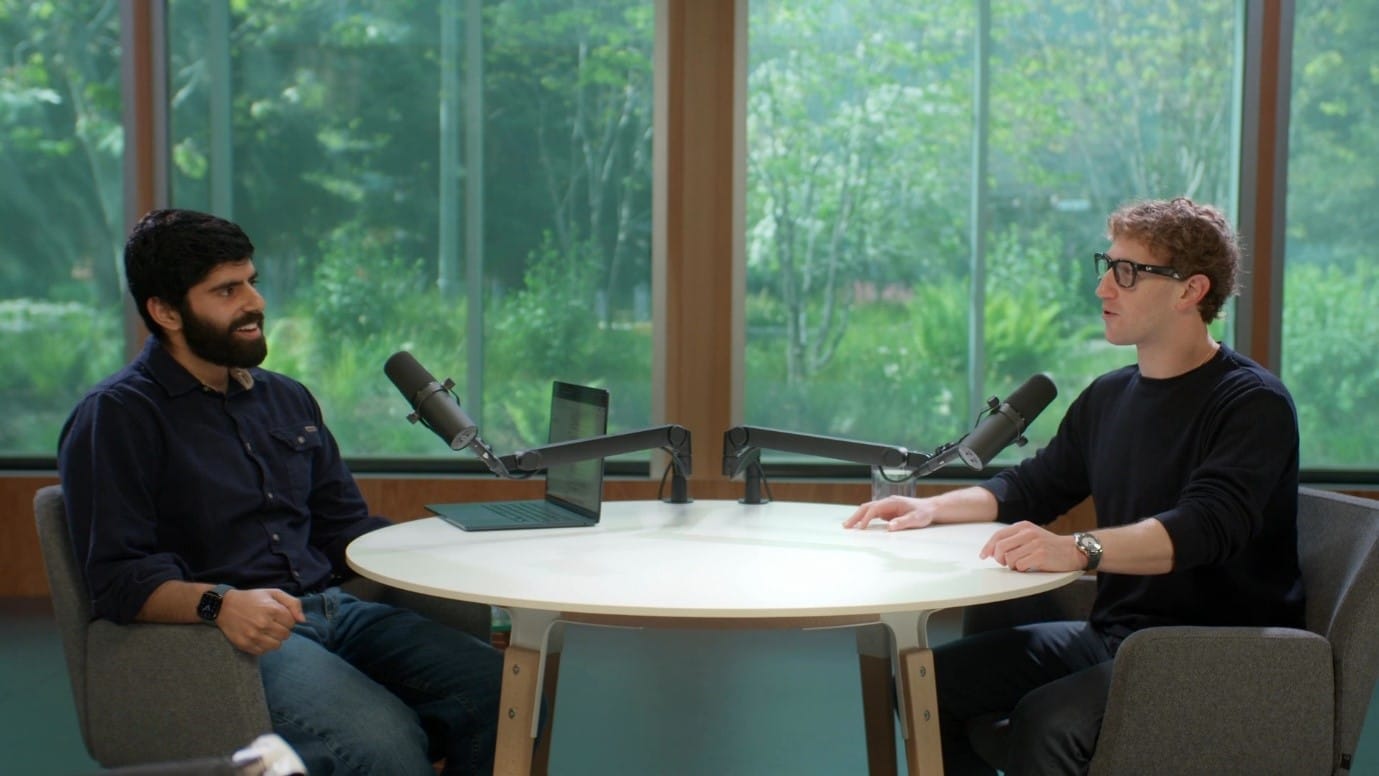
Bobby Fischer was a Chess genius no ordinary competitor could compete with: he became Grandmaster at the age of 15 and is known for being undefeated (11-0) in the 1963/1964 U.S. Championship, the only perfect score in the history of the tournament. The Oracle of Omaha, Warren Buffet was once asked “how do you beat Bobby Fischer?” and his response was “You play him in any game except chess”. Tech Investor Naval Ravikant made a point which sharpens this even further: escape competition through authenticity. Since no one can compete with you on being you, the fastest way to escape competition is not to become a better version of everyone else, but to amplify the qualities only you can possess and project them to the world. Nobody embodies that principle more than Dwarkesh Patel. He went from graduate student at University of Texas to full-time podcaster and leveraged his deep, intellectually curious personality to become one of the most important AI and tech podcasters in the world. His interview with NVIDIA CEO Jensen Huang in April 2026 took the internet by storm, cementing his status and position. It turns out the simplest way to escape the maze is to become yourself so clearly that the world cannot help but notice.
Build on top of existing infrastructure
What can we learn from influencers that have created and scaled their brands exponentially in the past decade? Leverage the infrastructure available to you. Indeed, over the past decade we’ve witnessed creator businesses leverage the zero marginal distribution costs that the internet offers to build lean multi-million (& in some cases billion) dollar businesses. A similar opportunity exists today, as we are witnessing some of the fastest growing AI native businesses emerging. This is evident if you study the Lean AI Leaderboard, which tracks lean AI native businesses employing 29 people on average & generating approx. $40M in revenue per employee on average. There, however is some nuance to this. As we will explore, the presence of the Ghosts in the Maze, the ability to reach customers and time are all factors that create nuances for the success of this approach.
The Legal AI Royal Rumble: The Case of Legora vs. Harvey vs. MikeOSS vs. Anthropic vs. Microsoft
Coatue is a tech-focused +$70B investment management firm investing across public and private markets. They recently published an insightful infographic highlighting the scale of the AI application layer: 50% of new private companies valued at $5B and above are AI apps. There’s a widespread debate regarding the viability of AI-wrapper companies, these are companies that build apps, products or software on top of foundational models, and add a user interface, workflow logic and guardrails. The argument against is usually that the AI labs (Ghosts) will just undercut the market and own everything. However, as the CEO of DecagonAI put it, the reason AI wrappers can capture a lot of the value is because they’re solving the actual problems and friction points these businesses have. It takes a lot of time to think through the features that businesses require, which the AI labs might not have as their focus is often on improving the performance of their models. The deployment efforts from the labs signal that this is changing very quickly and is becoming a matter of time.
The legal industry offers the greatest visual depiction of the ongoing debate surrounding AI wrappers, with a Royal Rumble battle emerging. The first two contestants in the ring are Harvey and Legora, two of the fastest growing AI companies founded less than four years ago targeting the legal industry. Harvey is valued at $11B while Legora is valued at $5.5B. The follow-up contender is Claude for Legal, AI agents and tools prebuilt by Anthropic specifically to automate legal work for lawyers and law firms. Claude for Legal comes with AI workflows contracts, privacy, employment, litigation, corporate work, IP etc. Then you have MikeOSS, an open-source web application built and shipped in 2 weeks from a former Latham & Watkins Associate. MikeOSS markets itself as the “Open-Source Alternative to Harvey and Legora”. The final contestant in this Royal Rumble is Microsoft, which recently introduced a new Legal Agent in MS Word, built to support and follow structured legal workflows.
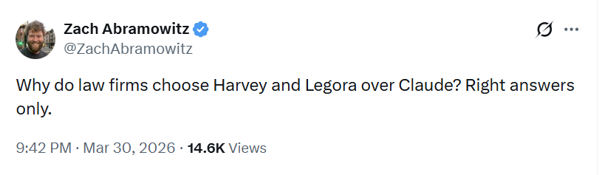
This isn’t WWE Wrestlemania, so there doesn’t need to be a zero-sum outcome with one absolute winner. Harvey recently shared that 67% of law firms ranked in the AmLaw 100 and Vault 100 use their product. Legora revealed that within 30 days of launching their recent campaign with Jude Law, they generated $50m in qualified leads to their sales pipeline. MikeOSS shared they have about 7,000+ users on the hosted site. What this dynamic demonstrates is that Go To Market, Distribution & the ability to meet service requirements are elements that matter more than the tech itself. Claude for Legal may exist but law firms that don’t understand how it solves or improves their specific workflows may prefer to use Harvey or Legora that offer around-the-clock support and access to a range of different models. Every legal contract at some point goes through Word but users that aren’t aware of the new legal agents may never use it.
LegalAI offers the best depiction of the Pac Man Maze thesis. If you’re Harvey, Legora and MikeOSS are the Ghosts in the Mirror. Microsoft is the Ghost with Why Shouldn’t I Syndrome leveraging its distribution to compete with you. Finally, Anthropic is the Lean Ghost Growing Exponentially rolling out new features that keep you up at night. Harvey was built using GPT4, MikeOSS with Claude. Building on top of existing infrastructure remains a legitimate Power Pellet, but it is not a permanent shield, distribution matters. The ghosts monitor which corridors are getting crowded, and they will come. The deciding factor for whether Harvey or any AI wrapper escapes the maze is ultimately the strength of every other Power Pellet it has managed to consume along the journey, not the model it sits on top of.
A new era for Agencies
Y Combinator is one of Silicon Valley’s most prestigious institutions, having backed many companies that have redefined our world. For the past two decades, they have avoided funding agencies and service firms citing difficulties in scaling, low-margins and a dependency on people rather than code. This is the exact opposite of software or software-enabled business with high gross margins, strong network effects, and clear scalability beyond headcount growth. This year marked a historic reversal on this stance, with YC explicitly adding AI-native agencies / AI-native service companies to their public “Request for Startups”, which highlights the companies YC is eager to fund. YC’s reasoning is two-fold: 1) AI fundamentally shifts the unit economics of services, as models can perform complex work far beyond engineering. 2) Global spending on services eclipses spending on software, and many of these services are already outsourced.
Building a new kind of agency on top of existing infrastructure is thus a new power pellet. It suggests that the companies that escape the maze may not be pure software companies at all but rather AI-native service businesses that combine human judgement with machine leverage to increase throughput and deliver outcomes with a speed that older service firms could never match. Still, the nuance matters. An agency is not defensible simply because it uses AI; if anything, that only lowers the barrier to entry for the next competitor, inviting more Ghosts in the mirror. What will matter, as always is what distinguishes the service delivery: workflow ownership, specialisation, trust and the ability to solve customer problems. The opportunity is real and YC’s shift makes it impossible to ignore. Agencies have entered a new era, but in a maze of full of ghosts, the agencies that make it to other side are those that either redefine the agency model from inception or reinvent what already exists.
The Power Law Power Pellet
The final Power Pellet is the Power Law Pellet. In an age of extreme power laws, one of the smartest moves a challenger can make is to deliberately venture into industries, sectors, countries, or cities that are already benefiting from powerful secular trends and network effects. In a world shaped by Zipf’s Law, choose to ride the current instead of fighting it. Some great examples of this are the AI data labelling companies, specifically Micro1, which opportunistically pivoted from an AI recruitment service to a data labelling provider. That single decision helped revenues skyrocket from $7M to $100M in less than 12 months. This is what makes the Power Law Pellet so important: it gives challengers a chance to advance to the next level by aligning themselves with a wave that is already building, even with the Ghosts still moving through the maze.
Conclusion
When Toru Iwatani created Pac-Man, his intention was to create a non-violent video game that anyone could play at the arcade. The game’s design was partially inspired by survival. Decades later, Pac-Man has transcended video games and, as laid out above, serves as a powerful framework for thinking about what it takes for challenger businesses not only to survive but thrive in an era of extreme concentration and K-shaped outcomes. The Pac-Man Maze Thesis draws on the visual design and simplicity of Pac-Man to create a framework that anyone can easily understand and apply. The Thesis is dynamic, visual, and accounts for the speed of change in a way other existing frameworks were not designed to handle.
The beauty of the Pac-Man Maze Thesis is that its application goes beyond small businesses and startups into many other facets of life where the convergence of extreme power laws creates significant pressure. Take for example, a young adult living in one of Europe’s large metropolitan cities, like Paris, Lisbon, or London, and aiming to become a property owner. The ghosts exist here too; they just take a different shape: high income taxes, rising property prices, sellers unwilling to sell at what they consider to be discount prices, and wages that have not kept up with inflation or asset prices. Just like in the game, each ghost operates independently, each with their own explanation and logic, yet appear to move in coordination.
Another example is an up-and-coming agribusiness in West Africa. Here, the ghosts morph into weak regulation affecting input availability, banks refusing to lend and making it harder to access capital, and staff leaving for greener pastures. In both scenarios, the Power Pellets differ, and their effectiveness against the Ghosts will vary, but they exist.
At the end of The Age of Extreme Power Laws, I asked a simple question: what will you do if you come to the realisation that the forces of power laws are converging against you? In the Pac-Man Maze Thesis, I offer the perspective from someone who has made that realisation, highlighting how the maze is becoming more crowded with fewer exits. My answer is that you can’t outrun every ghost, but you can understand which Power Pellets are available to you and which corridors are worth entering at all.
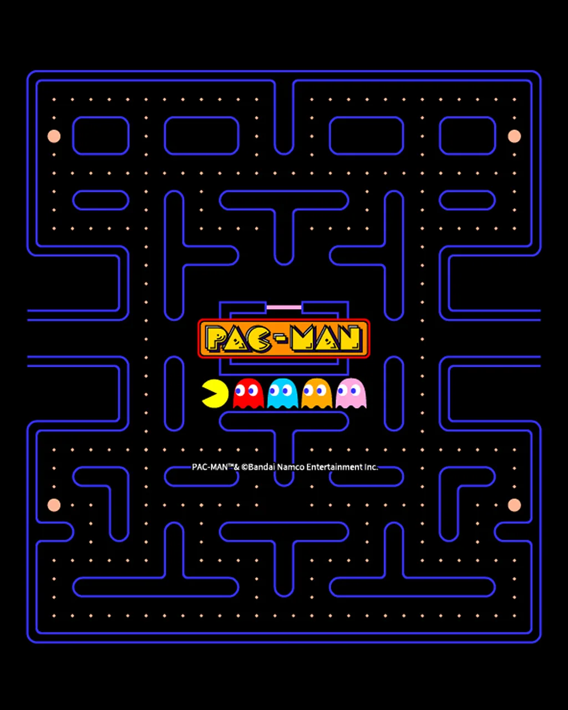
The best way to understand the framework is to play the game yourself: